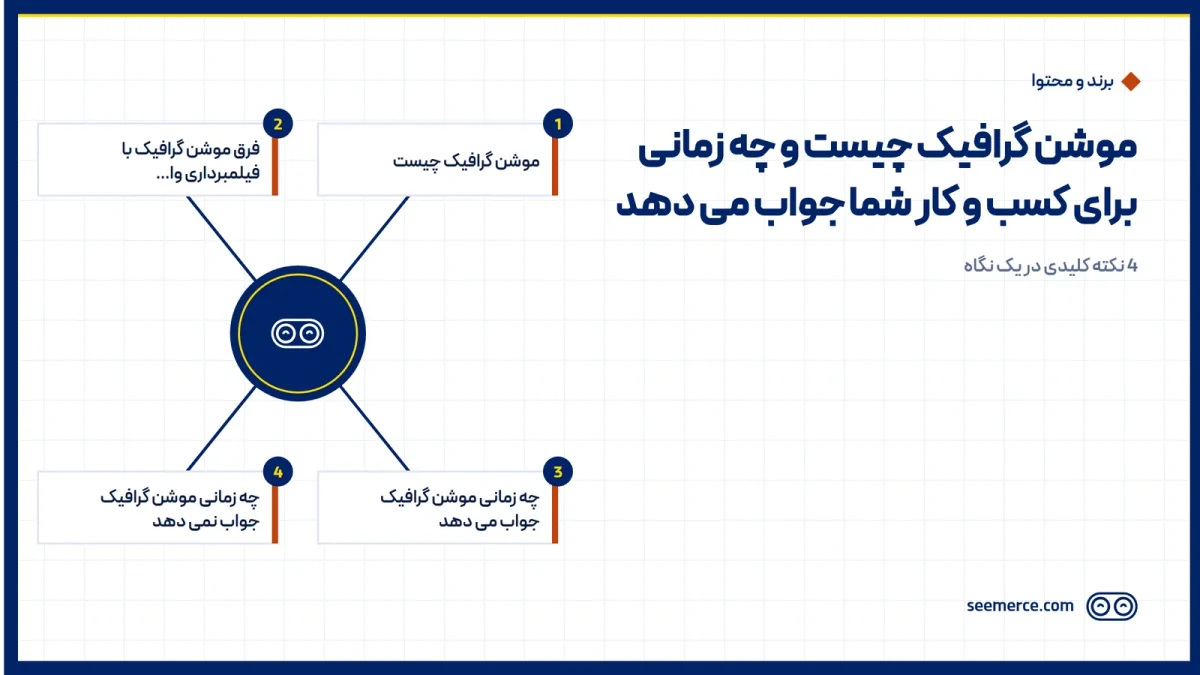
You have probably seen motion graphics on a competitor's page or in an app explainer video, and wondered whether it is worth it for your own business. This post gives a plain, no-hype answer: what motion graphic video actually is, how it differs from live-action film and simple animation, and the concrete situations where it works for a business — and where it does not.
What motion graphic video is
Motion graphics means animating graphic elements — text, icons, shapes, charts, logos — to tell a message. Unlike live-action video, there is no camera or actor involved; everything is built and animated inside software. Unlike character animation, there is no attempt at complex emotional storytelling; the focus stays on communicating a concept, not narrating a story.
In practice, a typical motion graphic video is built from these pieces: a short script that defines the message path, a storyboard that shows frame by frame what appears on screen, visual design aligned with the brand identity, and finally animation and sound. The whole thing happens on a graphics screen, not in a film studio.
Motion graphics vs. live-action video vs. simple animation
These are three common options for a promotional video, and each has its own use case:
- Live-action video: real people, real environments, high trust and intimacy. Best for team introductions, customer testimonials, or showing a physical product in the real world.
- Character or story animation: character development, longer storytelling, higher production cost and time. Better suited for brands building a full visual world.
- Motion graphics: faster and cheaper than both of the above, unbeatable for explaining an abstract idea or process — like how software works or the steps of a service.
The short version: if your message is about something you cannot physically show — a process, a system, a statistic — motion graphics was built for exactly that. If your message is about one person trusting another, live-action wins.
When motion graphics is the right call
There are a few specific situations where motion graphics reliably pays off:
- App or SaaS explainer video: when your product is software and you need to show, in 60 to 90 seconds, how a user interacts with it — motion graphics lets you simulate the interface and workflow directly.
- New product launch: when a product is coming to market and you need to communicate its core benefit fast, in one short video.
- Internal training: onboarding processes, safety training, or announcing a new policy to staff — where message consistency and easy future updates matter.
- Social media ads: short, colorful format with on-screen text that still makes sense with the sound off — exactly how content gets consumed on Instagram and LinkedIn.
- Landing page hero video: when you want the first few seconds of a visitor's session to communicate your value proposition without needing them to scroll.
If your business fits one of these categories, motion graphics usually gets results faster than live-action filming. For cases that are more complex or need coordination across several teams, we usually start from the motion graphic services page to figure out exactly what kind of video fits that specific business.
When motion graphics is not the right call
We are writing this section honestly, because the goal is not to sell a service at any cost:
- When your real need is trust built through a real face — like customer testimonials or a founder introduction — motion graphics cannot replace a real voice and a real face. Audiences can tell the difference between a real person and an animation.
- When the budget is genuinely tight and you only have a few days, sometimes a simple image carousel or a handful of good product photos does the same job without the cost of video production.
- When your product is physical and its real visual qualities — texture, material, actual movement — are part of the sales pitch, like food, apparel, or handmade goods, live-action filming usually gives a better result.
How long motion graphic production takes and what the steps are
A typical promotional animation, from script to final delivered file, takes roughly two to four weeks depending on video length and the number of review rounds. The main steps, in order, are: defining the message and audience, writing the script, storyboarding, designing key visual frames, animation, and finally voiceover and sound mixing. Each step needs sign-off before moving to the next, so late-stage changes do not drive up production cost.
One thing rarely mentioned: the quality of a good motion graphic video depends more on the script than on the visual design. If the message is cluttered and unclear from the start, no amount of animation can save it. That is why a large share of project time goes into finalizing the script, not the visual effects.
What we don't do
Let's be honest about what motion graphics does not solve. A good video does not replace a defined content or brand strategy; if your brand's visual identity is not yet defined, it is better to settle that first and build the video after — otherwise the video will clash with the rest of your site's content. For that, we usually start with graphic design to lock down brand colors, fonts, and visual language first.
A motion graphic video alone also does not bring traffic; it needs to be placed somewhere — on a product page, in an ad campaign, or on social media — to actually be seen. We do not guarantee virality or a specific view count, because that depends on the distribution channel, not just video quality. And if the project's budget or timeline does not allow for a few real rounds of revision, it is better to set expectations lower from the start so neither side ends up disappointed.
Frequently asked questions
How much does a motion graphic video cost?
It depends on video length, animation complexity, and the number of revision rounds. A simple 30-to-60-second video is priced differently from a two-minute video with complex animation. The best way to get an accurate quote is to send a short project brief.
Can I get a motion graphic video without professional voiceover?
Yes. Some clients just want the raw video with background music and order voiceover separately, or skip it entirely — for example, for videos meant to run without sound on social media.
Is the final file usable on Instagram, on the website, and on TV?
Yes, the output is usually delivered in several aspect ratios (square, vertical, horizontal) so it can be used across different channels without quality loss. This needs to be settled at the very start of the project.
How long until I see the first draft?
The initial storyboard is usually ready within a few business days, so the overall direction of the video gets approved before animation work begins. This prevents wasted time going down the wrong path.
Comments & Questions
Have a question about this article? Ask, we'll answer.
No comments yet; be the first.