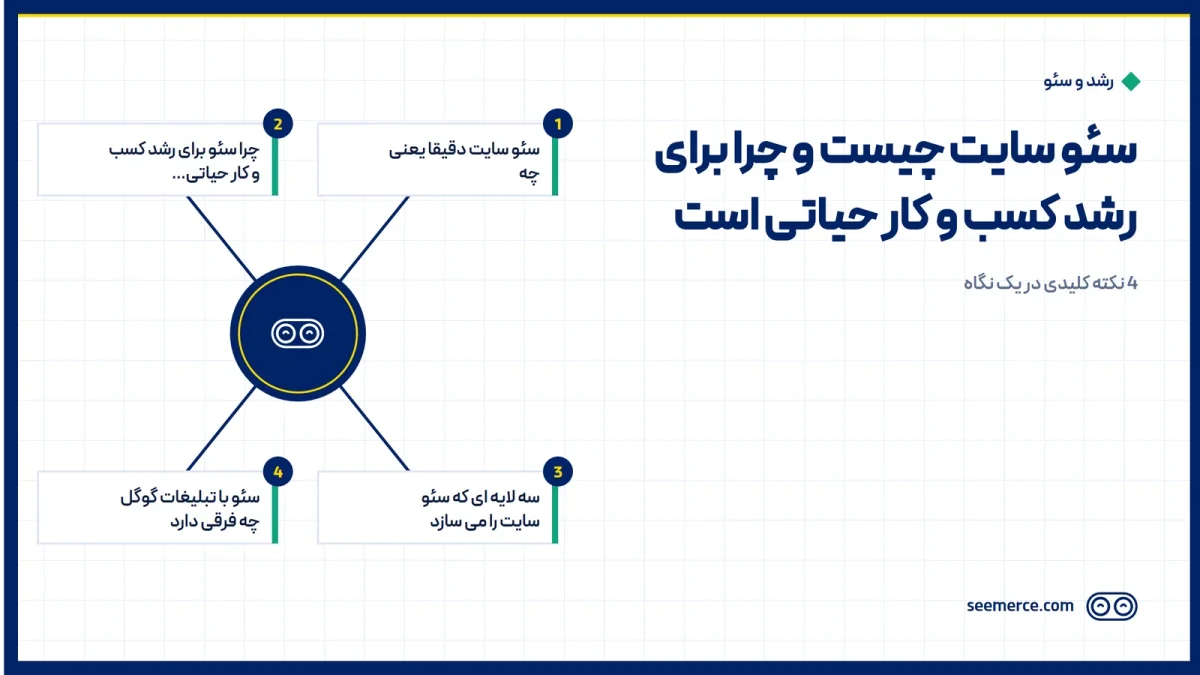
You've probably heard the phrase "you need to work on your SEO" more than once. What's often unclear is what that actually means, what changes as a result, and why it deserves time and budget. This piece explains, plainly, what website SEO actually is, what it's made of, and why it's an infrastructure investment for business growth, not a side expense.
What website SEO actually means
Website SEO means that when your potential customer searches Google for the exact service or product you offer, the result in front of them is your site, not your competitor's. That definition is simple, but it hides an important point: SEO doesn't create new demand; it routes existing demand to the right place. If nobody is searching for your product at all, SEO alone won't create customers — that demand has to be built first, through advertising or social media.
In practice, SEO isn't a one-time job; it's a monitorable system. Every month, new data from Search Console and keyword rankings gets reviewed, and the next decision is based on that data. Anyone who tells you SEO just means "stuffing a few keywords into the text" is describing one small fragment of the whole picture.
Why SEO is critical for business growth
Advertising, whether Google Ads or social media ads, brings traffic only as long as the budget is being paid; the day payment stops, traffic stops too. SEO is the opposite: the cost is time and ongoing work, but the result becomes an asset. A page that ranks for a keyword keeps bringing traffic for months, sometimes years, without extra spend.
The second reason is trust. A user who clicks an organic Google result unconsciously trusts it more than someone who clicked an ad, because they feel Google "chose" this result rather than someone paying for it. For a lot of businesses, that difference affects the final conversion rate too.
The third reason is long-term competition. If your competitor already ranks for the core keywords of your industry today and you don't, every month that passes widens their domain gap (authority accumulated from backlinks and content). Starting later means a longer road to the same point.
The three layers that make up website SEO
SEO can be summed up in three main layers that need to move forward together, not separately:
- Technical infrastructure: load speed, internal link structure, mobile version, correct indexability by Google, and the absence of technical errors that block pages from being seen.
- Content: pages that answer a user's real question or need precisely — not pages written just to "fill up the site." This layer includes producing new content and rewriting existing pages based on real user intent.
- Domain authority: backlinks from real, relevant sites pointing to yours. This layer works like a domain's resume; the more credible the sources linking to your site, the more trust Google places in it.
If you only work on one of these three layers, the result stays limited. Great content on a site that loads slowly gets seen less; a slow foundation puts a ceiling on SEO growth. On the other hand, a fast, clean site without proper content has nothing to rank with either — content is what Google actually reads and indexes, and this is exactly where the quality of content writing directly affects SEO results.
How SEO differs from Google Ads
A question many business owners ask is: why SEO instead of ads? The answer isn't that one is better than the other; these two tools are built for two different time horizons. Google Ads gives an instant result — clicks and visits from day one — but the moment budget stops, traffic drops to zero. SEO, by contrast, takes roughly three to six months for medium-competition keywords and six to twelve months for high-competition ones to show a noticeable result, but once you reach that rank, the cost of maintaining it is far lower than continuous advertising.
In practice, most serious businesses use both in parallel: ads for immediate short-term traffic, SEO for building a long-term asset. If your decision horizon is under three months, SEO isn't the right choice; the honest recommendation at that point is ads.
How to tell your site needs SEO
A few simple signs usually show it's time to start. If most of your site's traffic comes from ads or social media and direct traffic from Google is negligible, that channel hasn't been invested in. If your direct competitor ranks above you in searches for your own service or product name, they started earlier. And if Search Console shows a high number of impressions but low clicks, the problem is usually the title and meta description of your pages, not a lack of content.
The right way to start isn't guessing; it's an initial analysis of the site's current state. That analysis pinpoints which layer the main problem is in — technical, content, or domain authority — and priorities are set based on that data. The website SEO page explains this free initial analysis and the execution steps that follow it.
What we don't do
Much of SEO's bad reputation in the market comes from unrealistic promises. For transparency, here's what's explicit:
- No rank guarantees are issued. Google's official documentation explicitly states that no service can guarantee a specific rank; anyone who makes that promise either hasn't seen your project or is hiding the truth.
- We don't work on zero demand. If there's no search demand for your product or service at all, SEO can't manufacture it from nothing; that demand has to be built in the market through another method first.
- We don't propose SEO for a horizon under three months. For urgent needs, advertising is the most honest recommendation, even when it means no contract gets signed.
How website SEO relates to the rest of digital marketing
SEO isn't a separate, isolated channel from the rest of your marketing activity; it's part of a bigger picture. The content written for SEO is the same content shared on social media or used in an email campaign. The authority a site earns through SEO also affects overall trust in the brand. That's why SEO is usually seen as one part of a business's overall digital marketing strategy, not a standalone project disconnected from everything else.
Frequently asked questions
How long does website SEO take to pay off?
Usually three to six months for medium-competition keywords, and six to twelve months for high-competition ones. Early improvements from technical fixes are often visible in site traffic within the first four to eight weeks.
Is SEO only useful for e-commerce sites?
No; corporate sites, WordPress sites, e-commerce stores, and local businesses each need a different approach, but all of them benefit from SEO, because all of them want to be found when customers search for them.
What's the difference between on-page and off-page SEO?
On-page SEO covers work done on the site itself: speed, structure, content, tags. Off-page SEO is mostly about authority-building and backlinks from other sites. Both are necessary; neither replaces the other.
Once optimized, does a rank stay fixed forever?
No. Google's algorithm and competitor behavior keep changing constantly, so SEO isn't a one-time project; it needs monthly monitoring and continuous updates to hold on to the rank you've earned.
How often people search for this, in four markets
The difficulty index on "what is seo" is 100 out of 100, on 40,500 searches a month. That combination is the clearest signal in this table: high demand does not mean an opening. A page published today competes with a decade of accumulated links.
| Term entered | Monthly search volume | Click cost | Ranking difficulty | User goal |
|---|---|---|---|---|
| what is seo | 40,500 | $2.05 | 100 | Informational |
| technical seo | 14,800 | $4.03 | 62 | Informational + Commercial |
| on page seo | 12,100 | $5.28 | 70 | Informational |
| seo checklist | 8,100 | $3.01 | 50 | Informational |
Data from Semrush, US database, retrieved 27 August 2026. Search volumes change over time, so treat anything older than three months as a trend rather than an exact figure.

Comments and questions
No comments yet. If you have a question, we'd be glad to hear it.
Write a comment