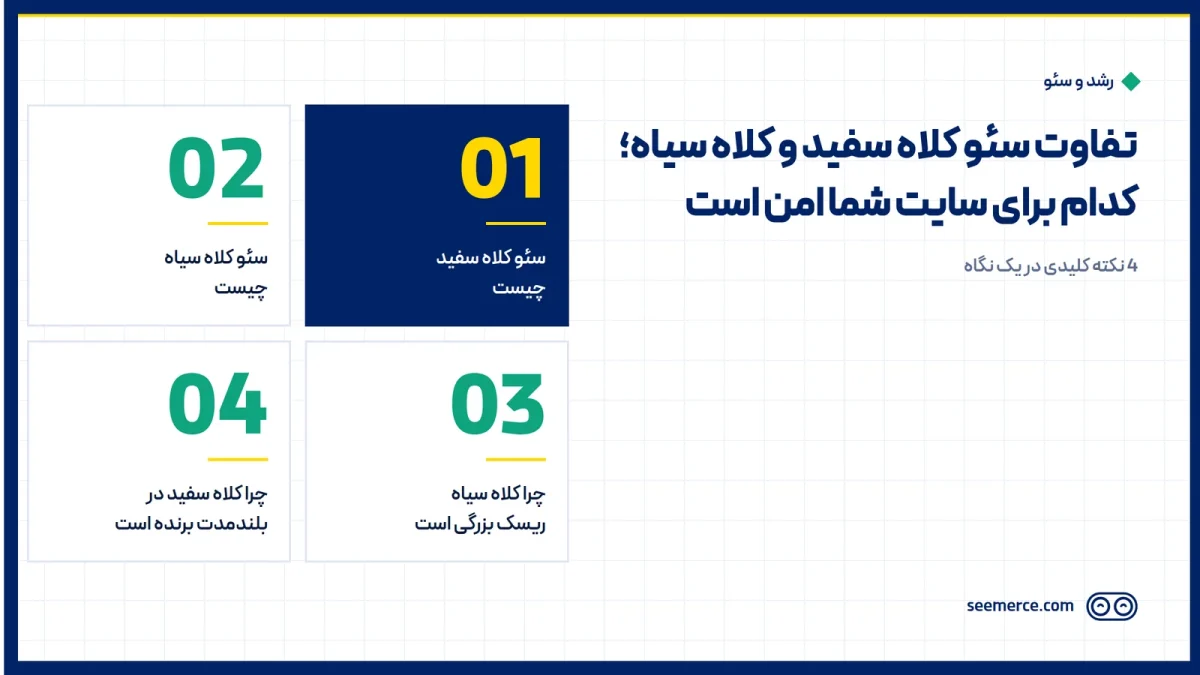
If you've spent time around SEO, you've probably run into the terms "white hat" and "black hat." These two terms refer to two completely different approaches to ranking on Google, and picking the wrong one can wipe out years of work on a site overnight. This piece looks at the real difference between the two, and which one is safe for your site.
What white hat SEO is
White hat SEO means fully following Google's official guidelines for webmasters. In this approach, rank is earned through real improvements to the site: quality content that genuinely answers the user's question, a healthy technical structure, good user experience, and backlinks earned naturally based on the content's real value. Results from this method show up later, but they're stable, and the risk of a Google penalty is close to zero.
What black hat SEO is
Black hat SEO means using methods that directly violate Google's guidelines to get a faster, cheaper rank. Common examples of these methods include: buying bulk backlinks from low-quality sites or link farms, hiding text or links from users while showing them to Google (cloaking), excessive keyword stuffing in text, and copying or superficially rewriting other sites' content without any real added value.
These methods sometimes work in the short term, which is exactly why they're tempting; but Google's algorithms get better at detecting these patterns every year. Once detected, the penalty can range from a severe ranking drop to complete removal from search results.
Why black hat is a major risk
The main problem with black hat isn't that it's "unethical"; it's more practical than that: the risk sits on your site's asset, not on whoever sold you the service. If an agency penalizes your site with bulk backlinks, that same agency usually takes no responsibility for fixing that penalty, while restoring Google's trust in a penalized domain can take months or even years, and sometimes isn't possible at all short of switching domains.
Another point is that a Google penalty isn't always immediate or obvious; sometimes the drop happens gradually with no clear notification, and it takes the site owner a while to realize the cause of the drop was black hat decisions from months earlier, not a simple technical problem.
Why white hat wins in the long run
White hat SEO is slower — that reality can't be denied. But because it's built on real value for the user, it stays independent of Google's frequent algorithm changes; when Google releases a new update aimed at detecting low-quality content, a site that produced quality content from the start has nothing to worry about. In fact, many of Google's major updates are specifically designed to remove black hat's advantage from search results, which means in the long run, the right path has always been white hat.
The gray area: where the line isn't clear
Between these two extremes, there's also a gray area that isn't always purely black or white — for example, limited, topically relevant link exchanges, or rewriting competitor content with real research and added value. These aren't inherently dangerous, but they sit close to the line with high-risk methods and need to be done carefully, with the content's real purpose in mind (helping the user, not tricking Google). A simple test: if what you're doing only makes sense for Google's algorithm and has zero value for a real human, you're probably in dangerous territory.
Which approach is safe for your site
Short answer: for almost no serious business is black hat a safe option. Even if it works short-term, the risk of losing the site's entire digital asset (which includes years of accumulated content and authority) is far bigger than the short-term gain. For a site meant to stay active for years and be part of a business's brand, investing in real, quality content — like what's pursued in content writing — is always the safer choice.
Examples of Google specifically targeting black hat
Over the years, Google has released several major updates specifically aimed at fighting black hat methods. One well-known update focused on sites producing shallow or copied content just to fill pages with keywords; another update focused directly on unnatural backlink profiles and link buying, and a lot of sites that had ranked for years using that method lost their rankings within days. This history shows Google not only recognizes these methods, but dedicates significant resources to detecting and penalizing them — a trend that gets stronger every year, not weaker.
The impact on brand trust, not just rank
A point that gets mentioned less often is that black hat damage isn't limited to rank. If a site gets penalized for low-quality or misleading content and removed from search results, customers who previously discovered it through that site can no longer find it again; that means losing a traffic channel whose rebuilding, unlike an ad campaign you can switch back on tomorrow, takes months.
How to make sure your site's SEO is white hat
The simplest way is complete transparency from the team working on your site: where backlinks are sourced from, what content is being produced, and on what basis. The website SEO service is built exactly on this principle: technical audit, real content based on user intent, and authority-building only through outreach on real media, with no bulk backlinks or copied content whatsoever. Every monthly report shows exactly what was done, so no ambiguity remains about the method.
What we don't do
Transparency matters in this area too:
- No black hat method is executed, even at a client's request. The risk stays on the client's domain, and it isn't a responsible choice.
- Bulk backlinks or link farms aren't part of the service. Authority-building happens only through outreach on real, relevant media.
- An instant result isn't promised alongside a safety guarantee. Any approach that guarantees an instant result is very likely using gray-area or black hat methods.
Frequently asked questions
Does Google always detect black hat SEO?
Not necessarily always immediately, but algorithms get more precise every year, and the risk of getting detected rises over time, not falls.
If my site used black hat in the past, what should be done?
First, low-quality backlink sources need to be identified and removed where possible, or disavowed with Google's Disavow tool, then weak content needs to be reviewed and replaced with quality content. This process takes time, but it's the only way to rebuild Google's trust.
Are all fast SEO methods considered black hat?
No; some technical fixes (like resolving a speed or indexing error) can also produce relatively fast results without violating any guideline. Speed of result on its own isn't a sign of black hat; the method used to get there is the sign.
How do I know if the agency I work with uses a safe method?
Ask them to explain exactly where backlinks are sourced from and what content will be produced. Full transparency in these details is usually a good sign; dodging a precise answer is a warning sign.

Comments and questions
No comments yet. If you have a question, we'd be glad to hear it.
Write a comment