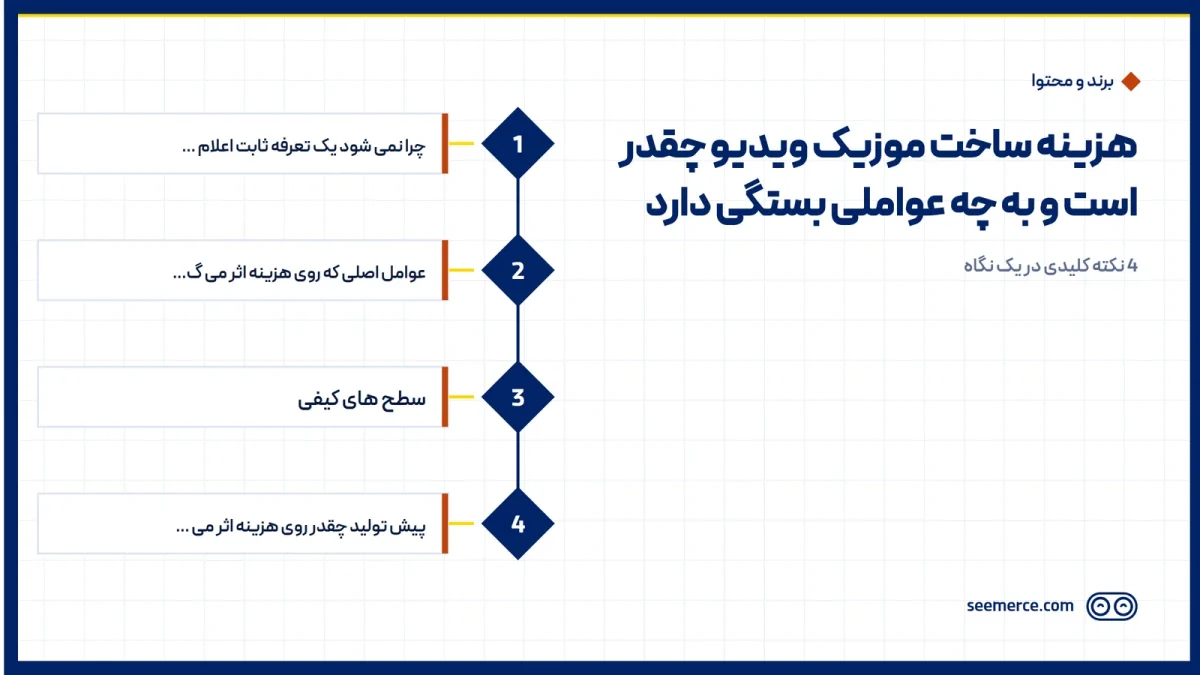
One of the first questions every artist, producer, or label asks before making a music video is how much it will cost. The honest answer is that there is no fixed number, because unlike a lot of advertising work, a music video is a fully custom product. A simple one-location performance video and a multi-location narrative video with visual effects live in two different worlds when it comes to time, crew size, and equipment. In this post we break down the real factors that shape the price of music video production, so you walk into a quote with a realistic picture of what your budget needs to cover.
Why there is no single fixed rate
The price of a music video depends as much on the number of moving parts in the production as it does on picture quality. Two songs with the same budget can call for completely different treatments; one needs a story and actors, the other is just the artist performing in front of the camera. That is why any serious studio looks at the treatment before quoting a price, so it knows exactly what is being built.
The main factors that affect cost
When people talk about music video shoot costs, these are the elements that move the budget up or down the most:
- Number of shoot days and locations: every extra day repeats crew fees, equipment rental, and location coordination. One location means one lighting and set setup; multiple locations mean moves, transit time, and separate coordination for each.
- Cast, dancers, and extras: professional actors or dancers add fees and rehearsal time to the project. The number of extras also affects on-set logistics — transport, wardrobe, coordination.
- Wardrobe and styling: from renting or designing outfits to hair and makeup, cost scales with how many looks change throughout the video.
- Lighting — practical or studio: using natural light and a real location is usually cheaper than building a full studio set with cinematic lighting, but the look is also different.
- Camera, lens, drone, and stabilizer gear: higher resolution, cinema lenses, drone shots, or smooth gimbal movement all add to rental costs and require a specialized operator.
- Color grading and VFX: a simple cinematic color pass is a different amount of work from a layered composite that needs VFX and compositing hours.
- Choreography and rehearsal time: if the video involves dance or coordinated movement, choreography design and rehearsal with the group has to be scheduled and budgeted before the shoot day.
- Post-production and revision rounds: editing, syncing to the master track, color, and final delivery all take time; more revision rounds mean a longer timeline and more editor hours.
Production tiers — not a price, but a scope
Instead of quoting a number, it helps to describe three tiers we typically see in the market, so you can tell which one your project is closer to.
Simple one-location performance video
The artist performs in front of the camera in one location, lighting and set stay fixed, and the edit is cut to the track's rhythm. This is the fastest, simplest production and needs the fewest resources.
Narrative video with a short story
A simple storyline, maybe one or two supporting actors, a couple of locations or one location with a few different set designs, and more deliberate color grading. Needs more shoot time and more editing time.
Multi-location concept production
A mix of narrative, choreography, possibly VFX or a designed set, several shoot days across multiple locations, and a larger crew in front of and behind the camera. This tier needs serious pre-production coordination and more post-production time.
An exact number for any of these tiers can only be given after we see your treatment, music style, and visual references. If you want to see what we have produced so far and how our pre-production, shooting, and delivery process works, check the music video service page and request a quote from there.
What we don't do
Let's be honest about why we don't publish a fixed price list on the site. A generic number like "music videos starting at X" is actually misleading, because the real cost of every project depends on the same variables listed above; a fixed number either makes the work look overpriced or sets an expectation that doesn't match the actual budget in practice.
The other thing we don't do is cut rehearsal and choreography time to hit a lower number. Movement that hasn't been rehearsed enough shows on camera, and the final result suffers for it; if the budget is tight, the right move is to reduce the scope of the shoot — one location instead of three, for example — not to compress rehearsal.
We also don't promise a rushed delivery that ignores the real editing schedule; rushing post-production is usually where color quality, the mix, and lip-sync accuracy take the hit.
Planning for release and promotion
Production cost is only half the story; the other half is how the video gets seen after it's finished. Plenty of producers take the production budget seriously but have no plan for release. If you want to see a real return on this investment, it helps to have a promotion and release plan running alongside production; our digital marketing team can design that part alongside the video itself.
FAQ
What is the cheapest type of music video?
A single-location performance video with practical lighting and no cast or complex choreography is usually the fastest and cheapest to produce, since it has the fewest pre-production and post-production variables.
Does more locations always mean higher cost?
In most cases yes, because every new location means coordination, moving crew and gear, and sometimes more waiting time. But a single location with a complex set design can sometimes cost more than two simple locations, which is why you need to look at the whole treatment, not just the location count.
How long does final delivery usually take?
It depends on the project tier and the number of revision rounds. A simple video is usually delivered faster, while a concept production with visual effects needs more time for color and compositing. We set the exact timeline together in the project plan.
Can I get a cost estimate before signing a contract?
Yes. Once you share your initial idea or treatment, your music style, and any visual references, we give you a realistic estimate based on that information.


Comments and questions
No comments yet. If you have a question, we'd be glad to hear it.
Write a comment