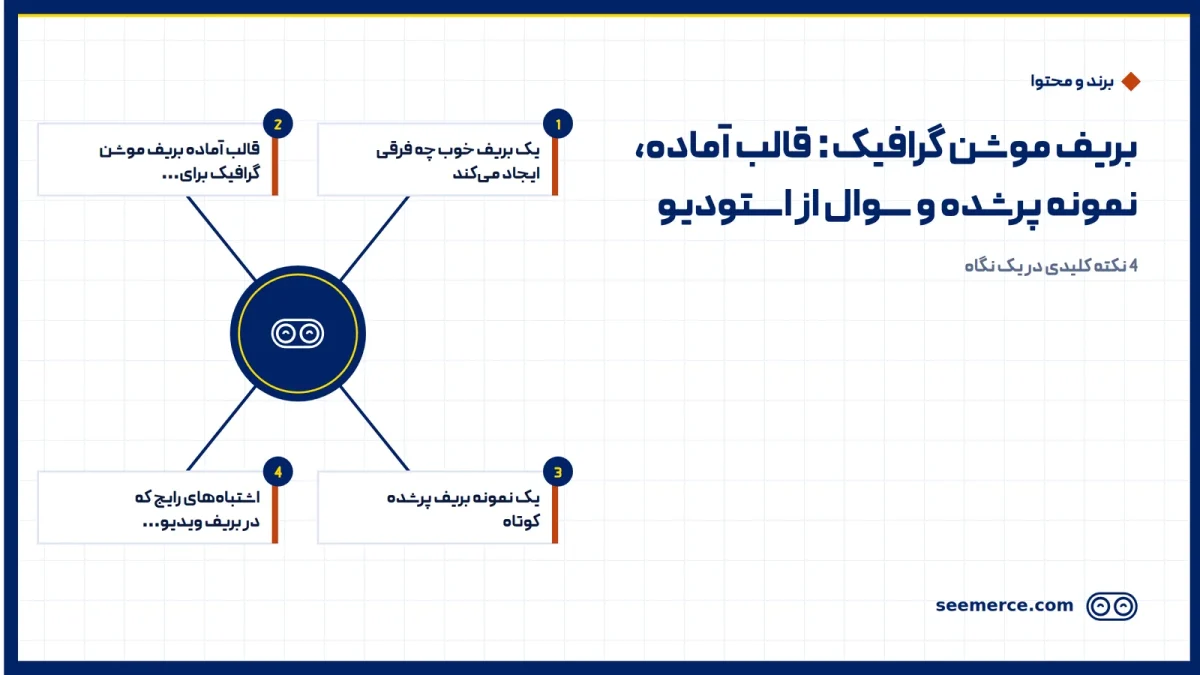
A motion graphic brief is a short document. It tells the studio what the video is for, who will watch it, which message has to stick and what you need to receive. A good brief fits on one or two pages and answers 13 clear questions. In this post we share a ready-to-fill template for those 13 points, show a filled-in example, and then cover what to ask a studio before you sign and which signs are worth a pause.
What a good brief actually changes
Our experience says this: most extra revision rounds don't come from weak animation. They come from a video whose goal was never clear in the first place. Without a brief, the studio guesses. You only find out what you don't want after seeing the first draft.
A clear brief has three direct effects:
- Price and timeline get more accurate, because the studio knows the length, the style and the number of versions.
- The script reaches an approvable draft sooner, because the core message is already chosen.
- Reviews stay on details, not on changing the direction of the whole video.
You don't need technical words to write a brief. Plain, honest sentences are enough. If you don't know the answer to a point, write that down, and we'll work it out together in the first call.
A ready-to-fill motion graphic brief template you can copy
Copy this table and fill in the second column for your project. The order is deliberate; each point builds on the one before it.
| Point | What to write |
|---|---|
| 1. Goal and one measurable outcome | What the video should achieve and the number you'll judge it by, such as click-through rate, sign-ups or fewer support calls. Only one main outcome. |
| 2. Audience | Who watches it, in what situation and with what concern. "Everyone" isn't an audience. |
| 3. Single key message | The one sentence that, if viewers remember nothing else, means the video worked. One sentence, not three. |
| 4. Call to action | Exactly what the viewer should do at the end: install, call, buy, sign up or visit a specific page. |
| 5. Platforms and aspect ratios | Where it will run and in which frame: 16:9 landscape, 9:16 vertical, 1:1 or 4:5 square. Each frame needs its own layout. |
| 6. Length | Target duration in seconds. If you need several cuts (say 30 and 15 seconds), list them here. |
| 7. Tone | Two or three adjectives, such as "warm and formal" or "fast and playful". Add one you don't want, too. |
| 8. Brand assets | Vector logo, colour palette, fonts, brand guidelines and product images. If you don't have guidelines, just say so. |
| 9. References you like and dislike | Two or three of each, with the reason. "I like this" doesn't help; "fast rhythm, few colours" does. |
| 10. Deadline | The real publish date and whether it can move. Mention any event or campaign date. |
| 11. Language versions | Persian, English or another language; voiceover, subtitles or both. |
| 12. Approvers | Who approves drafts and in what order. Name one person as the final decision-maker. |
| 13. Budget range | A realistic floor and ceiling. A range helps the studio propose the best mix of style and length within it. |
Point 13 is the hardest one for most people. If you're not sure what range makes sense, our post on what drives motion graphic cost shows which choices move the price.
A short filled-in brief example
Imagine a booking app for local hair salons wants a short promo video. Its brief could look like this:
- Goal: more app installs in a new city. Main metric: cost per install in the first month of the campaign.
- Audience: women and men aged 20 to 40 who waste time booking salon appointments by phone.
- Key message: "Book your salon appointment in under a minute."
- Call to action: "Install the app and book your first appointment."
- Platforms and frame: vertical 9:16 stories and reels, plus one 1:1 square version for the feed.
- Length: a 30-second main cut and a 15-second short cut.
- Tone: friendly and clean; no heavy jokes.
- Assets: vector logo, two brand colours, the brand's Persian font, screenshots of the booking screen.
- References: we like soft movement and lots of white space. We don't like heavy on-screen text, because it can't be read on a phone.
- Deadline: publish at the start of next month; the date can't move.
- Language: Persian only, with voiceover and burned-in subtitles for silent playback.
- Approvers: marketing manager, then CEO; the marketing manager has the final say.
- Budget: a set range that covers flat 2D motion graphics.
That single page already tells us the voiceover for the 30-second cut should be around 65 to 75 Persian words. Natural Persian narration runs at about 2 to 2.5 words per second. So there's no room for three features: one feature, one booking scene and one call to action. We fill in the rest together during motion graphic script writing.
Common mistakes to avoid in a promo video brief
These are mistakes we see again and again in the briefs we get, with a simple fix for each:
- Several goals at once: brand awareness, sales and hiring in one video. Fix: pick one main goal and save the rest for later versions.
- Too many messages: a list of ten product features. In 30 seconds, viewers remember one. Choose that one.
- Undecided frame: a landscape video that later has to turn vertical rarely survives a simple crop; the scenes usually need redesigning.
- References without reasons: a bare link leads to different readings. Always say what you want from that reference.
- Hidden approver: someone who wasn't involved early on and changes direction at the final draft. Put them on the approver list from day one.
Choosing a motion graphic studio: ask these before you sign
Once your brief is sent, it's your turn to size up the studio. Ask these questions, and get the answers in writing:
- Who writes the script? Is there a writer on the team, or do they expect the script from you? Is writing included in the price, or extra?
- How many revision rounds are included, and at which stages? Script, storyboard (scene-by-scene sketch) and animation rounds are different. Ask how they define "one round", too.
- How is music licensed? Is the music cleared for commercial use? For which platforms, and for how long?
- Who owns the source files? Will you get the animation project files and design files, or only the final export? You'll need them if you want a new version later.
- What are the delivery formats? Resolution, frames, versions with and without subtitles, a textless version for localisation and a separate audio file.
- What is the process, and the timeline for each stage? A schedule with your approval points. We've written ours up in the motion graphic production process, so you know what to expect each week.
A simple rule for comparing: only compare two proposals once they answer these six questions the same way. A cheaper offer without source files or music licensing is really a different service.
Red flags to take seriously when choosing a studio
These don't necessarily mean bad work, but each is worth one more question:
- A firm price before seeing a brief or having a first conversation.
- A portfolio that's all one style while a different style is being promised to you.
- Vague answers about music or font licences, like "we'll find something online".
- No stage for approving the script and storyboard before animation starts.
- A contract that doesn't state revision rounds, delivery formats or file ownership.
- A very short turnaround promised for character or 3D animation, with no explanation of what gets simplified.
To see what our packages cover, take a look at packages and how we price.
What we don't do
- We don't give a firm price without a brief or a first conversation; even an incomplete brief is enough to start.
- We don't drop the script and storyboard to save time.
- We don't use unlicensed music, fonts or images.
- We don't hold source files back; their delivery terms are written into the contract from the start.
- We don't squeeze more than one main message into a short video; instead we suggest several short cuts.
Have a brief ready, or half-done? Send it through the Seemerce contact page and we'll complete it together.
Frequently asked questions
How long should a motion graphic brief be?
One to two pages is enough. If each of the 13 points has a short answer, the studio can give an accurate estimate. More detail can be added in the first call.
Can I order if I don't know my key message yet?
Yes, but it's best to dedicate the first stage of the project to clarifying the message. In that case we start with a few questions about the audience and the goal, then move on to the script.
Should I receive the video's source files?
Yes, if you plan to make language versions, new frames or an updated cut later. What matters is that source-file delivery terms are written into the contract before work begins.
Should I put my budget in the brief, or wait for the studio's quote?
It's better to give a range. A budget range prevents irrelevant proposals and lets the studio suggest the style and length that fit it.

Comments and questions
No comments yet. If you have a question, we'd be glad to hear it.
Write a comment